
Colorado has two distinct homestead protections. One shields a limited amount of equity in a qualifying home from certain creditor claims. The other reduces property taxes for eligible seniors, veterans with qualifying disabilities, and surviving spouses. Some homeowners may qualify for both.
A home can be your largest asset and your biggest source of financial uncertainty. If you’re looking into the Colorado homestead exemption, the first step is to identify the protection you need. Creditor protection concerns the equity you have in your home. Property tax relief concerns the value used to calculate your tax bill.
Those protections can also affect decisions about ownership, a move, or an estate plan. Birch Grove Legal’s asset protection planning services can help you look at your home in the context of those broader decisions.
Colorado homestead protections at a glance
The two protections serve different purposes and follow different rules. Start here to see which one addresses your concern.
The $100,000 figure in the property tax row is exempt home value, not a $100,000 reduction in your tax bill. Your tax savings depend on the applicable assessment and tax rates.
How Colorado’s creditor homestead exemption protects home equity
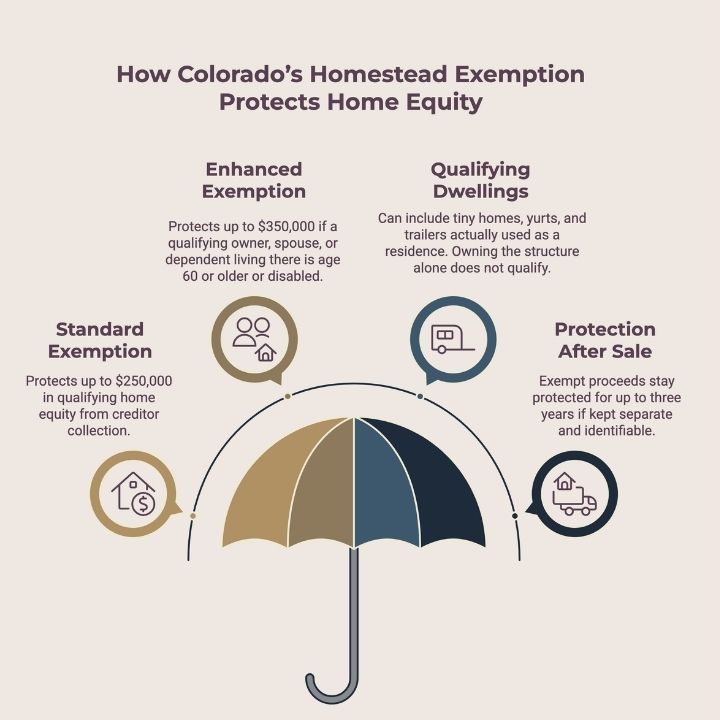
If a creditor seeks to collect a debt, Colorado law protects a limited amount of equity in a qualifying home. The applicable limit depends in part on who occupies the home.
Standard and enhanced home equity limits
The standard Colorado homestead exemption protects up to $250,000 in qualifying home equity. The limit increases to $350,000 if the home is occupied by an owner, the owner’s spouse, or the owner’s dependent who is elderly or disabled. For this purpose, Colorado defines elderly as age 60 or older. These are limits on protected equity, not payments to the homeowner.
Dwellings and household members that may qualify
A qualifying home isn’t limited to a conventional house. Colorado’s definition can include a trailer, vessel, camper coach, shipping container, yurt, tiny home, or other property actually used as a residence. The enhanced limit may depend on the status of an elderly or disabled owner, spouse, or dependent who lives there.
What matters is the property’s use as a home and the facts of the household. Owning a structure on the list does not, by itself, establish an exemption.
Protection for identifiable proceeds after a home sale
Selling a qualifying home does not necessarily end the protection immediately. Exempt proceeds from a sale can remain protected for up to three years after receipt if you keep them separate from other money so they can be identified. Certain insurance proceeds held to restore or replace a homestead may also qualify.
If a sale is approaching, plan where the proceeds will go before they arrive. Mixing protected proceeds with everyday funds can make them harder to trace. Colorado’s homestead legislation sets out these rules.
Who qualifies for Colorado property tax homestead relief?

Colorado’s property tax programs address a different expense: the annual tax bill on an eligible primary residence. Each eligibility category has its own requirements, and homeowners must apply.
Senior homeowners and qualifying surviving spouses
For the standard senior exemption, a homeowner generally must be 65 or older as of January 1 of the application year and have owned and occupied the home as a primary residence for at least 10 consecutive years. A surviving spouse may qualify under the rules that apply to the deceased spouse’s exemption.
A move can change eligibility, so don’t assume an approval follows you to a new address. The senior property tax exemption requirements explain the ownership, occupancy, and application rules.
Veterans with qualifying disabilities and Gold Star spouses
The property tax exemption can also apply to a veteran with a qualifying permanent, service-connected disability. Certain veterans with individual unemployability status, surviving spouses of qualifying veterans, and Gold Star spouses may qualify under their respective rules. Applicants should review the property tax exemptions for qualifying veterans and surviving spouses and confirm the documentation required by their county assessor.
Exempt value, applications, and the 2026 deadline
The exemption generally removes 50% of the first $200,000 of a qualifying home’s actual value from taxation. That means up to $100,000 in actual value is exempt; it does not mean every approved homeowner saves the same dollar amount.
The 2026 application window has closed. An approved 2026 exemption first appears on the tax bill sent in early 2027. Colorado also offered a temporary Qualified Senior Primary Residence Classification to certain seniors who had previously received the senior exemption but lost eligibility after moving. Under Colorado’s 2026 property tax law, that classification ends after the 2026 property tax year. Homeowners planning a later application should check the current rules with their county assessor.
How each Colorado homestead protection takes effect

The creditor exemption generally arises under the law when its requirements are met. Property tax relief requires an application. Knowing that distinction helps you take the right step at the right time.
Asserting creditor protection during collection or bankruptcy
You generally do not file an advance application to create the creditor homestead exemption. If collection, enforcement, or bankruptcy proceedings begin, however, you may need to identify the property and assert the exemption. The protected amount depends on the applicable limit, the home’s equity, and the circumstances of the case.
Filing a property tax exemption application
Submit the form for your eligibility category to the county assessor where the home is located. Seniors, veterans, and surviving spouses may need different forms and supporting records. If the home’s ownership changes, including a transfer into a trust or LLC, ask the assessor if a new application is required to continue an existing exemption.
Douglas County homeowners can find the relevant applications on the Douglas County assessor forms page. Homeowners elsewhere in Colorado should use their own county assessor’s forms.
What Colorado homestead protections do not cover

An exemption has boundaries. Before relying on one, look at the type of claim against the home, the amount of equity involved, and how the property is used.
Mortgages, tax liens, and other excluded claims
The creditor homestead exemption does not erase a mortgage or deed of trust. Certain liens, including federal tax liens, may also remain enforceable. If you’re facing a specific claim, the type of debt and lien matters as much as the exemption amount.
Property tax relief serves a separate purpose. It reduces taxes on qualifying value; it does not protect the home from a lender or resolve an existing debt.
Excess equity and properties that do not qualify
Equity above the applicable $250,000 or $350,000 creditor limit may be exposed to qualifying creditor claims. A second home, vacation property, or standalone rental also should not be assumed to qualify as your homestead.
For property tax relief, primary residence and applicant eligibility requirements apply. If you own multiple properties or recently moved, confirm which address qualifies before filing.
Protect your home through a coordinated Colorado asset plan
The right first step depends on the problem in front of you. A creditor claim calls for a close look at home equity and the nature of the debt. A property tax question calls for an eligibility and application check. A planned sale or change in ownership may require both.
These protections have different limits, and the outcome depends on facts such as occupancy, title, household status, and the type of claim. An exemption should be assessed alongside your estate plan and other asset protection decisions, especially before you sell or retitle a home.
Call Birch Grove Legal at (720) 713-7093 to discuss your options. Book a Free Consultation to discuss your home, your plans, and the next step that fits your situation.
Frequently asked questions about Colorado homestead exemptions
These answers address the questions homeowners most often ask when comparing the two protections.
What is the homestead exemption in Colorado?
The term can refer to Colorado’s creditor exemption, which protects limited equity in a qualifying home, or to property tax relief for eligible seniors, veterans with disabilities, and surviving spouses. The rules and required steps depend on which protection you mean.
Do people over 65 have to pay property taxes in Colorado?
Yes. Qualifying seniors may receive an exemption on 50% of the first $200,000 of their home’s actual value, but they can still owe property taxes on the remaining taxable value. Age alone does not establish eligibility; ownership, occupancy, and application requirements also apply.
What form is used for the homestead exemption in Colorado?
There is no single form for both protections. The creditor exemption generally does not require an advance application. For property tax relief, use the application for your eligibility category from the county assessor where your home is located.
Does Colorado’s creditor homestead exemption apply automatically?
It generally arises when the legal requirements are met. You may still need to assert it during collection, enforcement, or bankruptcy proceedings. Do not assume the exemption will be considered without raising it in your case.
Can a second home or rental property qualify for homestead protection?
Do not assume it will. Creditor protection concerns property actually used as a home, while the property tax programs generally require an eligible primary residence. The property’s use and your circumstances determine which rules apply.



0 Comments